Showing posts with label Jean Valjean. Show all posts

01 January 2013

Moving On...: Reflections on a Year Spent Hurdling Hugo

"Il dort. Quoique le sort fût pour lui bien étrange,/Il vivait. Il mourut quand il n'eut plus son ange./La chose simplement d'elle-même arriva,/Comme la nuit se fait lorsque le jour s'en va.

[He is asleep. Though his mettle was sorely tried,/He lived, and when he lost his angel, died./It happened calmly, on its own,/The way night comes when day is done.]"
- Victor Hugo (Les Misérables, V.9.vi [last lines])
 
Hugo Final Day Count: 366
Hugo Final Page Count: 2158

At the beginning of this year, I started a journey through the works of Victor Hugo. While my eyes were bigger then than my attention span is now, it has certainly been a fun ride, encompassing the scope of human emotions from unspeakable joy to inconsolable sadness and everything in-between.

The year started with the goal to read the largest novel I'd ever attempted - Victor Hugo's Les Misérables - and, in that respect, I was successful. And, while my accountability on the blog was certainly lacking in the last twelve months, my contact with my Twitter followers was at an all-time high and, I am quite certain, through my tireless efforts to tweet quotes and passages from the classic books I read, managed to convince a few of my friends and followers to take up this magnificent tome for themselves.

Les Misérables was, to be sure, one of the great literary experiences of my life. While I did not feel quite as enriched while reading it as I did upon completing War & Peace in 2011, upon further reflection, I find that it was a book that I will certainly carry with me as a favorite for the rest of my days.

I was discussing with a friend (a doctoral student in the theatre department at Tufts University) just yesterday the necessary changes in Aristotle's "elements of a well-made play" (or 'story'). He suggested that it is specious to apply what amounts to ancient and philosophical thoughts to modern story and playwriting techniques. When I prompted him as to what changes he would make to Aristotle's structure, he responded that, more than 'plot' (which Aristotle ranks highest of all other elements - which also include theme, character, music, and spectacle, among others), character is what drives most modern audiences in their pursuit of film, literature, and theatre. I had to admit, he had a point.

How often do truly compelling characters stick with us as an audience, as readers, as those ardent masses who desire to experience art for what it is? There is something about them that draws us in. More than the most fascinating plot or story, it is the characters that draw us in and help us to identify our place within the human puzzle. Given my experiences over the last two years, I would have to agree that the Romantic writers had a great handle on this idea.

One of the great things about the Romantics - particularly the Europeans - was their aptitude for taking a story that was, for all intents and purposes, epic and focusing, in the midst of this epic sprawl, on characters, on the people who drive the story forward. Of those great, grand stories, few balance the grandeur of subject with intimacy of character like Victor Hugo.

In the two novels of his that I read this year - Les Misérables and Notre-Dame de Paris - Hugo demonstrates a grasp of character that is unparalleled by many an author, a feat that may even eclipse that of Tolstoy, who's writing so influenced and enlightened me last year.

In Les Misérables, Hugo introduces us to two characters who are fundamental opposites (and yet, paradoxically, based on the same man) - Jean Valjean, the criminal who is shown mercy when he most needs it and, as a result, shows it to everyone he comes across; and Javert, the wolfish police inspector hell-bent by his fanatical devotion to the law of the land to see that Valjean answers for his various crimes. Their dichotomy has fueled innumerable conversations about the nature of justice and mercy - which certainly had to be Hugo's intent. Himself an activist and advocate for the poorest of people, Hugo clearly favors Valjean's ascent of grace to Javert's dive of justice - while both men ultimately die, it is Javert who kills himself due to his inability to justify the act of mercy shown him by Valjean, the man who he had sworn to bring to justice. Valjean, on the other hand, dies surrounded by his beloved adopted daughter and her husband, loved and beloved. As he tells his daughter with his final breaths: "Love each other dearly. There is scarcely anything else in the world but that: to love one another" (V.9.v). Or, to put it like it was said in the musical: "And remember the truth that once was spoken,/To love another person is to see the face of God."

Peppered among these captivating players are secondary characters who do not fail to ignite inspirational fires of their own: Marius, the schoolboy who scorns his beloved grandfather in order to pursue his love and his ideals; the Bishop of Digne, whose simple act of mercy acts as the catalyst for Valjean's complete turnaround; the tragic Fantine, whose story is perhaps one of the saddest I've ever encountered; the noble Enjolras and the nihilistic Grantaire, two polar opposites whose death is one of the most noble and heartbreaking in all of literature; the mischievous Little Gavroche, who refuses to take guff from any man, especially those bigger than him. All of these - and so many others - enliven this epic tale. Hugo's attention to forming them into fully-fledged people enhances a good story, transforming into a timeless classic.

Meanwhile, Hugo's first novel, Notre-Dame de Paris, also delivers on compelling characterizations, though of a completely different kind altogether. While these is something inherently emulatable in his Les Misérables creations (with the exclusion of the Thenardiers, of course), the characters in Notre-Dame de Paris (more commonly, and erroneously, referred to as The Hunchback of Notre Dame) bears characters that would appear to be more at home in a morality play than in a Romantic novel. Even more incredible is the idea that Hugo's main character is the titular Cathedral de Notre-Dame itself rather than any of the numerous characters that occupy the structure throughout the course of the novel.

Firstly, we are introduced to Claude Frollo, the archbishop of Notre-Dame driven mad by his lustful desires for the young la Esmeralda who herself becomes the object of desire of every principal male figure of the book. While nowhere near as cruel as most film adaptations of him, Frollo is nonetheless compelling - a man devoted to his studies and to his vows, until the sight of a beautiful young girl drives him to a most fatal obsession. In Frollo's care is the gentle Quasimodo, who stands out as the most compelling of all the characters of this novel, if for no other reason than the juxtaposition of his hideous outer appearance (see the following excerpt) with his inner gentle nature.
"We shall not attempt to give the reader an idea of that tetrahedral nose, that horseshoe mouth, that tiny left eye obscured by a shaggy red eyebrow, while the right eye lay completely hidden beneath an enormous wart. Those irregular teeth, with gaps here and there like the battlements of a fortress, that calloused lip, over which one of those teeth protruded like an elephant's tusk, that cleft chin, and above all the facial expression extending over the whole, a mixture of malice, amazement, and sadness. Conjure up, if you can, this overall effect." (I.v)
It is perhaps Quasimodo, of all the characters in the novel, who loves the most honestly and the most deeply. While his demeanor around so many others is anger, hatred, or brutality, it is la Esmeralda - the only soul who treats him as though he were human - whom he holds with the utmost affection, even at the expense of his relationship with his master, Frollo.

In addition to these, we are given snapshots of Captain Phoebus, whose heroics make him the apple of la Esmeralda's young eye, despite his engagement and constant womanizing; of Jehann Frollo, the younger brother of the archbishop, the mooching, drunken student whose loud and obnoxious behavior lead him to be among the first killed in the siege of the great Cathedral; of Pierre Gringoire, a real-life playwright, here given literary function as the man whom la Esmeralda marries in order to save him from death at the hands of the gypsies; of Gudule, the frightful sachette who has spent her life mourning the loss of her daughter and hating the gypsies who had stolen her. Throughout the tale it is, again, these vibrant characters who drive the narrative, giving it substance and life and meaning and depth.

Hugo's sketching of these characters is what makes his novels so classic and so compelling. More than the stories, which are still excellent, it is the characters that propel them. Even Tolstoy, who last year became one of my favorite writers, did not have such an emotional grasp of character. In two novels, he created five characters that I became completely enamored with - Andrei Bolkonsky, Pierre Bezukhov, Natasha Rostova, Anna Karenina, and Konstantin Levin. Hugo, on the other hand, has created three times as many, at least one of which - Jean Valjean - has been named among the most compelling characters in all of literature. While I can honestly say that Tolstoy composes the vast, sprawling narrative with more aplomb than Hugo, it is Hugo who creates the more relatable characters.

And perhaps it is that, above all, which I will take away from this year in my literary journey. 2012 is the year of the captivating character.
___________________________________

And, with that, ladies and gentlemen, that I bring this blog to a close. As I mentioned in an earlier post, I am broadening my scope in the years to come on this project. It is my hope that you will continue to follow along with my literary journey both at my new blog or my new Twitter feed (@ClassicLitTweet) and provide any feedback you so desire. My intent is to leave this site up and running (though largely untended) until such a time as I am able to get the contents copied to another site. In the meantime, remember: there is never a substitute for great literature!

01 June 2012

A Final Hesitation

"It is nothing to keep my peace? To keep silent is simple? No, it is not simple. There is a silence that lies and my lie, and my fraud, and my unworthiness, and my cowardice, and my treachery, and my crime, I would have drunk drop by drop, I would have spit it out, then drunk again, I would have finished at midnight and begun again at noon, and my 'good morning' would have lied, and my 'good night,' too, and I would have slept on it, and eaten it with my bread, and I would have looked Cosette in the face, and answered the smile of the angel with the smile of the damned, and I would have been a detestable imposter! What for? To be happy. To be happy, I! Have I any right to be happy? I am outside of life, monsieur."
- Jean Valjean (V.7.i)
Day Count: 153
Page Count: 1428

I stand at a threshold of a new achievement - with only 98% of the novel finished, I am decidedly a day away from completing Les Miserables. By the end of this week, that is to say, two days into the month of June, I will have finished an endeavor that I began at the first of this year. It's an exciting time, to say the least.

Still, I find myself confronted with a feeling I've not felt since I finished War & Peace last May. There is, welling up within me, a hesitation - something that holds me in a sort of suspended animation. Almost limbo. I don't want it to end. As the novel winds down, the former convict Jean Valjean reveals his true identity to Marius, who has married Cosette. After this realization Valjean begins to distance himself from the couple so as not to taint their happiness with his depravity (the discussion of which precipitated the quote that started this post).

As Valjean works to distance himself from Cosette, I find myself irrevocably drawn closer to him. As the pages to complete dwindles, I find that I can't bring myself to close that gap. I will miss these characters and I will miss that world. Tomorrow, I will post some concluding thoughts about the world of Les Miserables, but for now, I just want to revel in this brief moment of hesitation and expectation. It's quite the place to be...

Until next time...

27 May 2012

In Which Stephen Plans His Hiatus and Reflects on the Meaning of LES MISERABLES

"The book the reader has now before his eyes  - from one end to the other, in its whole and in its details, whatever the omissions, the exceptions, or the faults - is the march from evil to good, from injustice to justice, from the false to the true, from night to day, from appetite to conscience, from rottenness to life, from brutality to duty, from Hell to Heaven, from nothingness to God. Starting point: matter; goal: the soul. Hydra at the beginning, angel at the end."
- Victor Hugo (V.1.xx)

Day Count: 148
Page Count: 1305

Had I stuck to my initial "ten-pages-a-day" plan that I started with at the beginning of the year, I'd have finished reading Les Miserables yesterday. As it stands, I managed to fall a bit behind with the stress of finishing out the school year and still have somewhere around 160 pages left between myself and the finale. My goal is to have the novel finished before mid-June, which seems a completely realistic goal.

The best part about being a teacher is having several weeks off in the summer, time I plan to use to get some reading done. After Les Miserables, I plan to take a one month hiatus from the works of Hugo (returning in July to read Notre-Dame-de-Paris a.k.a. The Hunchback of Notre Dame), during which time I'll likely tackle The Hunger Games series by Suzanne Collins (if for no other reason than to find out what all the fuss is about). No, it's not "great literature" and I will likely not be blogging or tweeting through my reading of those books, but - the way I figure it - when you finish a meal, you get dessert, something light, sweet, and not necessarily nutritious, as a capper for your meal. The way I see it, The Hunger Games is my slice of cheesecake after the multi-course dinner that was Les Miserables.

The quote I used to start this post is taken from the first book of Volume Five (the volume named after the chief protagonist of Les Miserables, Jean Valjean) in the midst of a discussion of the need for Progress. As soon as I read it, I recognized it as Hugo's statement of purpose, something akin to a thesis statement for his novel as a whole.

Renown more in France for his activism and poetry than his novels, Hugo spoke out against the debasement of the poor in Paris that occurred even in his lifetime. In fact, every character in the novel fits into the category (at one time or another throughout the narrative) as one of "The Wretched Poor," which, coincidentally, is one of the American translations of the title Les Miserables.  Valjean was a convict; Javert, the son of two gypsy criminals; Fantine is forced into prostitution to care for her daughter; Cosette, that daughter grows up unloved and uncared for until meeting Valjean; the Thenardiers are greedy and deceptive, but live in abject poverty; Marius rejects his wealthy grandfather for the life of freedom, that is to say, the life of the impoverished. By making the poor characters that were both (a.) accurately poor (Hugo caught a lot of flack for allowing certain characters - i.e. Thenardier and his gang - to speak in argot, the language of the convict) and (b.) undeniably human, Hugo is able to open people's eyes - both then and now - to the realities of the life of the poor.

In fact, the only character in Les Miserables who was not at one time poor was the Bishop of Digne who, it will be remembered, stands out to my mind as one of the most ideally Christian characters I've ever encountered in literature. While the Bishop is a man of some means (by virtue of his position), he gives all that he has to those who fit the category of "The Wretched Poor." His house he gives to the neighboring hospital, the trappings of his parish he gives to a band of rebels, and - perhaps most famously - he gives his silverware and candlesticks to a former convict by the name of Jean Valjean. It seems clear - even from the beginning - that the Bishop of Digne is the 'ideal' to which the reader ought to desire to aspire, just as Jean Valjean does. The novel then depicts Valjean's ascent to that ideal - transforming "from evil to good." Would that we all were so motivated to aspire so highly.

At any rate, those are my thoughts for today. See you next time!

12 May 2012

A Little Matter of Character and Narrative (or Stephen Points Out Differences Between the Musical and the Novel)

"It's impossible that a mattress should have so much power. Triumph of what yields over what thunders. Anyway, glory to the mattress that nullifies the cannon."
- Bossuet (V.1.ix)
Day Count: 133
Page Count: 1208

It has been far too long since my last update and, for that, I apologize. Life has been pretty crazy-busy since March. Had I had the time and inclination to maximize the popularity that my blog underwent while writing my "Thoughts on Les Mis Film Casting" series (if you haven't, read parts one, two, and three now), I very probably could have found a way to garner more consistent readership, but so be it. Obviously, I'll never be a professional blogger!
I have a post begun and planned - perhaps one day I'll get to it - regarding my two week Les Mis binge: reading the book, watching the 1998 film, and seeing the Broadway touring company of the Les Mis musical. It was a great period and a wonderful artistic experience that I will (hopefully) one day complete and share with you all.

Today, however, I want to share one of the realizations I've become increasingly aware of in the past few weeks. I've shared several times before that my impressions of Les Miserables had been previously shaped by my exposure to both the film and musical adaptations of the story. For this reason, reading Les Mis has been a vastly different experience than, say, War & Peace was for me last year. With W&P, everything was a discovery. The characters, the story, the emotion - it was all new and exciting! With Les Mis, I feel like I already know these characters and have heard their story several times. It's not new - it's familiar.

That having been said, it's been quite an experience to have my perceptions of both of those works altered by what I've read in the novel. The characters I'm reading about are in many ways the same characters I know from my previous experiences, but in many ways they are different. And not just surface-level different. Vastly different.

I find this law at work: with but a few exceptions, the characters that I hated in the musical are the characters I am loving in the novel. Conversely, the characters I loved in the musical, I find myself hating in the book.

For example, my favorite characters in the musical are the Thenardiers. They may be smarmy and conniving, but they are hilarious! Monsieur Thenardier is actually one of my dream roles - I would love to play that character.. if only to sing "Master of the House!" The two of them certainly have their flaws, but they make up for it by providing their audience with the greatest gift imaginable - laughter!

The Thenardiers in the novel, however, are vastly different creatures than their singing and dancing counterparts. There is no laughter. No light-hearted banter. No quick-witted jabs or well-timed gags. Heck, they don't even have any show-stopping musical numbers! No, Hugo's Thenardiers are devious, diabolical, and cruel. That really is the best word to describe them, too - cruel. From the moment we see them, the Thenardiers are painted as treacherous opportunists with little-to-no redeeming qualities whatever. The trauma they put the young Cosette through is enough to make you hate them eternally... and then they find a way to further plummet themselves in your estimation. Unlike Tolstoy, Hugo doesn't seem to have as much of a problem with you despising certain of his characters completely.

I also loved the character of Eponine. I detailed in Part Two of my "Thoughts on Les Mis Film Casting" series the fact that she is the one we want to see end up with Marius because, unlike Cosette - who, despite one or two unpleasant circumstances in her childhood, leads a life of privilege - it is Eponine who is the underdog character. And we root for the underdog. It's a human thing. "On My Own" remains one of the best-loved, most recognized songs from the Les Mis musical and every word and melody draws the viewer to identify more and more with Eponine's point of view (far more than Cosette's "I Saw Him Once" or "A Heart Full of Love").

While there are some great moments with Eponine (her chasing off of her own father and his gang of thugs outside of Valjean's house on Rue Plumet springs immediately to mind), I find myself nowhere near as sympathetic to her plight in the novel as I was in the musical. Most of this, awful as it sounds, happened at her death for me. She takes a bullet for Marius so that he will live and, in the musical, the tender and touching "A Little Fall of Rain" takes place, further manipulating us into thinking Marius is an idiot for not loving the girl he had right there loving him the whole time (but more on that later). In the novel, though, her motivation for taking the bullet for Marius goes something like this:
"See, you're lost! Nobody will get out of this barricade, now. It was I who led you into this, it was! You're going to die, I'm sure. And still when I saw him aiming at you, I put my hand on the muzzle of the musket. How odd it is! But it was because I wanted to die before you. ... Oh, I'm happy! We're all going to die." - Eponine Thenardier (IV.14.vi)
Not only do we see Eponine committing suicide, but leading Marius to his own death so the two of them could die together. If she couldn't have Marius, no one would have him! This completely put me off of the character of Eponine altogether.

On the other hand, one of the reasons this bothered me so was because of the depth of feeling I felt for Marius Pontmercy. In the musical, I didn't really care for Marius. I felt he was a whiny, one-dimensional waif of a man who was singularly obsessed with a girl he'd only ever seen once. And while this isn't an entirely inaccurate portrayal of Marius, it is only the tip of the iceberg. The musical completely omits Marius' sense of honor - the debt he feels he owes the vile Thenardier for having rescued his father during the Battle of Waterloo many years previously. It omits his role in the events that lead to the collision of Valjean, Javert, and Thendardier on the streets of Paris. It eliminates his own sense of virtue and makes trite the supreme purity of his love for Cosette (another character I hate in the musical, but love in the book).

Earlier, I mentioned "a few exceptions" to the loving characters in the novel, but hating them in the musical... because there are characters in both that I cannot help but love regardless. They are, of course, Valjean and Javert, both of whom are very well developed in both novel and musical (though, naturally, much more so in the novel). But it also includes Enjolras, possibly one of the most inspirational characters in the novel, and vividly portrayed onstage as a pillar of idealism. (Although, as I'd mentioned before, it wasn't until he was portrayed by Ramin Karimloo that I really felt Enjolras was a great character. Before that, he would've easily been listed alongside Marius and Cosette.)

At any rate, this has been one of the most interesting things I've noted about my time spent in Les Miserables, especially as it's nearing its conclusion. I'm a scant 255 pages from the finish line and feel good about being able to wrap this book up toward the end of this month (or beginning of the next). Hopefully, it won't be another two months before you hear from me next. But, until then...

18 March 2012

Thoughts on LES MIS Film Casting (Part One): Valjean, Javert, Fantine, and Eponine

 "...there are many great deeds done in the small struggles of life. There is a determined though unseen bravery that defends itself foot by foot in the darkness against the fatal invasions of necessity and dishonesty. Noble and mysterious triumphs that no eye sees and no fame rewards, and no flourish of triumph salutes. Life, misfortunes, isolation, abandonment, poverty, are battlefields that have their heroes; obscure heroes, sometimes greater than the illustrious heroes."
- Victor Hugo (III.5.i)

Day Count:  78
Page Count: 688

I won't lie - much of my exposure to Les Miserables prior to this year had little-to-nothing to do with Victor Hugo's initial work. That is to say, I'd been exposed to adaptations rather than the original text.

My first exposure was the 1998 film starring Liam Neeson as Valjean, Geoffrey Rush as Javert, Uma Thurman as Fantine, and Claire Danes as Cosette. I watched scenes from it in my eleventh-grade Bible class during a study on Paul's epistle to the Romans. It was interesting to contrast the major themes of Romans - grace vs. the Law - with the themes of Les Mis, particularly the forgiveness of Valjean juxtaposed with the by-the-book lawfulness of Javert. While there were elements of the film I enjoyed, I definitely felt that there were things lacking... but I didn't really notice to what extent until I discovered the Les Mis musical in college.

My freshman year at Olivet Nazarene University, the student theatre organization - Green Room - took a trip up to Chicago to see the touring company of Les Miserables. I was entranced. From top to bottom, this was more or less the best show I'd ever seen. I was particularly enamored with the role of Thenardier (and still not-so-secretly hope to play it someday, despite my less-than-stellar singing ability). I ended up seeing the musical again my senior year at ONU and getting the soundtrack (Original London Cast, of course!).

So, when I found out that, after 25 years, producer Cameron Mackintosh was FINALLY making the musical into a film, I was... well, I was nervous. Musical films made within the last several years have been incredibly hit-or-miss. They're either incredibly well-received (Chicago, Dreamgirls, Hairspray, Sweeney Todd) or... something less than stellar (Nine, Rent, The Phantom of the Opera, Mamma Mia!). As a fan of both great movies and great musicals, I know that Les Miserables could stand to make either one of the best (or one of the worst) movie musicals in recent memory.

Academy Award-winning director Tom Hooper is set to direct the Les Mis musical adaptation... for which he probably hopes to win another of those glittery statuettes.
 Mackintosh and company have assembled an all-star cast, led by director Tom Hooper. Hooper was a relative unknown in America until last year when his film The King's Speech took home Oscars for Best Picture, Best Director, Best Original Screenplay, and Best Actor for its star Colin Firth. However, Hooper had already developed an impressive resume by directing The Damned United and the John Adams TV miniseries for HBO.

I understand Hollywood's desire for all-star casts. Honestly, I do. You have to get butts in seats, otherwise it doesn't matter how good your movie is, no one will see it. Star power is an important factor in movies making money because, after all, in Hollywood, movies are a business more than an art.

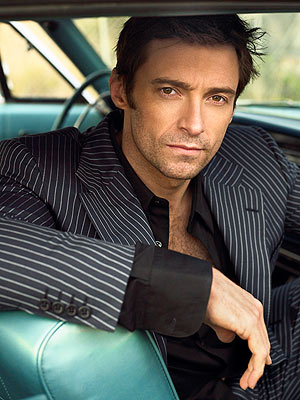
Hugh Jackman will be Jean Valjean... but can he act it?
This is why I wasn't really all that surprised to hear that Hugh Jackman and Russell Crowe had been cast as Valjean and Javert, respectively. Jackman is Hollywood's new "go-to" guy when it comes to singing and dancing. His stint as host of the Oscars a few years back was full of singing and dancing, including an elaborately choreographed tribute to movie musicals alongside Beyonce, Amanda Seyfried, Dominic Cooper, Zac Efron, and Vanessa Hudgens (ironic for a year where very few movie musicals were released), as well as an incredible opening number reminiscent of Billy Crystal's old openers (though with considerably more spectacle).

Jackman, who comes from a musical theatre background, seems like an obvious choice to play Valjean - he's got the vocal range, he's a big enough name to bring people in, etc. But will he be strong enough to pull off the complex emotional range of reformed criminal Jean Valjean? Granted, I've never thought of Jackman as a bad actor per se (numerous poor film choices notwithstanding), but none of his previous films have required the type of acting one would have to convey here... which is to say nothing of the believable aging he would have to undergo to go from Valjean at 40 at the play's beginning to Valjean at 75-80 at the end? While I know he's got the voice, I wonder if he can act well enough to pull off the main protagonist here.

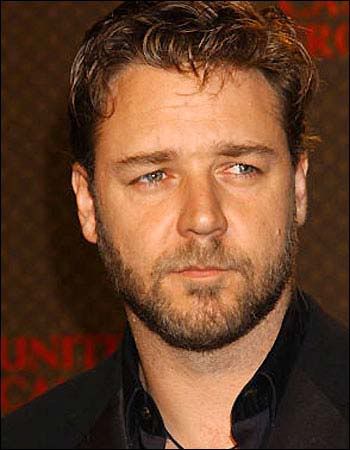
Russell Crowe will be Javert... but can he sing it?
Russell Crowe came as a bit more of a surprise. Not in terms of star power, of course. I mean, the guy is a three-time Oscar nominee (his sole win coming for the movie Gladiator) and he is a consistent fixture in great period dramas. No, my concerns with Crowe were the opposite of Jackman. While I have no doubt whatsoever about Crowe's ability to play the hardened gendarme Javert, my doubts lay in his ability to sing the classic Javert numbers like "Stars," "Confrontation," and "Javert's Suicide."

Apparently, though, Russell Crowe has been singing and performing musically since the 80s when he became part of the band 30 Odd Foot of Grunts (which has to be one of the most ridiculous band names of all time). Crowe's vocal stylings on these recordings are hardly as 'clean' as those acts typically associated with Javert - Terrence Mann, Philip Quast, and Roger Allam, to name a few of the more renowned. In fact, most of the YouTube clips of Crowe's singing make him sound like a grizzled old country singer... but then you come to a clip of him singing live at some awards ceremony and you can't help but wonder if he might be able to pull it off. Chalk me up as 'cautiously optimistic' for this one.

Anne Hathaway will be Fantine. Can she pull it off?
Then we come to Anne Hathaway as Fantine, a single mother propelled by her estranged daughter's happiness. In the book, Fantine is a broken figure and a lot of this carries through to the musical - she is without options and is caught in a downward spiral, forced to become a prostitute in order to pay for her daughter's care. I want to go on record before I go much further and say that I've long been a fan of Miss Hathaway. I'll be honest - she's really attractive. But more than that, she is also an incredible talent. Granted, she hasn't had too many opportunities to spotlight that talent, but there are certain roles she's played (including her Oscar-nominated performance in Rachel Getting Married) that warrant her consideration as a talented performer.

Not only that, but the girl has some pipes! If you didn't catch her performance in the opening number of the 2009 Oscars that Hugh Jackman performed, check that out... and then watch her parody of Les Mis staple "On My Own" at the 2011 Oscars (which she attempted to cohost with James Franco). So it's not a serious attempt, but she clearly has the range to pull off Fantine. I'm excited about this casting choice for no other reason than that I want Hathaway to do well here.

Samantha Barks will reprise the role of Eponine.


Samantha Barks beat out a laundry list of what would appear to be "Hollywood gold" to claim the coveted role of Eponine - the daughter of the unfortunate Thenardiers who is rejected by her true love, Marius Pontmercy. Among those up for consideration for the role included Glee's Lea Michele, Scarlett Johanssen, Evan Rachel Wood, and teen pop sensation Taylor Swift. But Barks, who had recently portrayed the role at the 25th Anniversary Concert at O2 Arena (opposite Nick Jonas as Marius... but more on that later), won out... and deservedly so, I think. Her portrayal of the role at the concert is, I'm convinced, what helped her edge out the other major contenders.

The best part about Barks' casting is that we don't have to wonder whether or not she's able to play it. We've SEEN her do it and she knocked it out of the park! And if you are one of the unlucky few that hasn't seen her portrayal, check out this clip of her singing "On My Own" (Eponine's perhaps-too-popular ballad) at the 25th Anniversary Concert. Barks captures every conceivable shred of emotion in this song and conveys it darn near perfectly. I remember commenting to a friend after seeing her rendition that her portrayal was among the best - if not THE best - that I'd seen. I could not be happier that she got cast in this role! (And couldn't be even happier that she won out over Taylor Swift.)

"Alright, Taylor, I'mma let you finish... but Samantha Barks had one of the greatest film auditions OF ALL TIME!"
(Sorry - have to strike while the iron is tepid and lukewarm. :))


Okay, so this ended up being a lot more time-consuming than I initially thought (what, with the links, the photos, and all), so I'm going to have to break this up into multiple parts. Part Two will be coming in a few days and will feature my thoughts on the casting of the roles of Marius, Cosette, and the Thenardiers. Stay tuned and watch this space!

_____________

Read the rest of this series:

20 February 2012

Picking Up the Ball & Attempting to Run With It

"Jean Valjean had this trait, that he might be said to carry two knapsacks - in one he had the thoughts of a saint, in the other the impressive talents of a convict. He helped himself from one or the other as occasion required."
- Victor Hugo (II.5.v)

Day Count: 51
Page Count: 464

Well... I've certainly been remiss in my updating, haven't I? In the 47 days since my last update, a lot has happened - I've wrapped up production on a fantastic community theatre play (which you can read about here and here should you feel so inclined), made what I consider to be some great strides in my professional life, and - of course! - have continued my trek through Les Misérables.

For a while (before we got into Hell Week on the last play), I had even managed to jump ahead of my early, unspoken goal of knocking back ten pages a night. With the hectic and often demanding nature of live theatre, the impressive lead I once enjoyed has been pared back to a just-shy-of-daunting setback, one I look forward to rectifying in the days and weeks to come!

One thing that I have noticed consistently about Hugo's prose is the power of his simplicity. Hugo doesn't use a lot of flowery verbiage and poetic language. Rather, he sticks to very clear, concise language, often keeping dialogue to a minimum in favor of creating a certain mood. Whether it is the overwhelming suspense created by carefully outlining a darkened Parisian street or the tragic heartache of a child having grown up without love, Hugo knows exactly how to evoke the appropriate emotional response from his audience. There have been moments where I just cannot help but marvel at the man's ability to so seamlessly craft a scene that can put even the most detail-oriented filmmakers to shame. (*coffcoffStanleyKubrickcoffcoffDavidOSelznickcoffcoff*)

Another thing I've loved so far about this reading experience is the fact that, much like the men and women who appeared in War & Peace and Anna Karenina, Hugo's characters are fully formed, not caricatures or stock characters, but real people who respond to each situation with the full force of their own humanity. We are shown the inner turmoil of a man striving to live according the higher standard to which he has been called; a self-righteous inspector who unwaveringly upholds the law his own family so carelessly disregarded; a pair of seasoned con artists weaving their trail of deceit throughout France; a woman abandoned by love who somehow manages to cling to the thinnest shreds of hope; and a small child growing up unloved and unwanted, becoming an unwitting pawn in a short-sighted long con.

These are my inadequate facsimiles of the masterfully crafted characters that Hugo presents to his audience. At times, they are courageous; at others, they are pitiful. Other times, they are heart-breaking; still others, they are life-affirming. What they are never, however, is boring.

Perhaps my favorite of these characters - so far - is the man I quoted in my first Les Mis post some 47 days ago and the man whose singular act of grace becomes the catalyst for the entire action of the novel - the Bishop of Digne. Never before have I seen a character that is at once so human and so challenging. He is, as near as I can tell, one of the most potent and accurate examples of the Christian ideal as I have ever read in literature (discounting the Scriptures, of course). His consistent outpouring of love for all - not merely the wealthy or the politically powerful or even the ones who agree with him - is what ultimately sets the novel in motion when he encounters a lowly convict named Jean Valjean and purchases his soul with forgiveness and silver. A more fitting beginning to a book I have not yet read... and never before has a fictional character so motivated me to look at my own faith as a result.

I feel as though I've accomplished much in the last 51 days of reading Les Mis... but I still have quite a ways to go!

More to come...